
How the Miami County Court Calendar Works
The Miami County District Court publishes a Docket by Date calendar through the official Sixth Judicial District Court page. It can be viewed for a chosen date or judge. The county says it tries to update the calendar each day, yet it also calls the display reference information. A hearing, continuance, or reset may have occurred before staff process the change. That warning is central to any Miami County court schedule search.
The inspected PDF was generated by CalendarOJA and covered a long job range. It grouped events under the Miami County District Court heading and showed dates, times, courtrooms, case numbers, event types, lawyers, and party roles. A broad report range does not mean each line is an immediate hearing. Narrow the view to the needed day or judge, then verify the setting that affects the case.
Miami County Docket by Date
Open the county's official Docket by Date PDF before calling the courthouse. It is the fastest local view when the key question is who is set, when the matter is called, and which event label appears. The PDF can also be useful when a name search in Kansas CaseSearch produces several results.
The county gives a special print method for an attorney's schedule: highlight the relevant entries and use File > Print. That feature makes the Miami calendar useful for a focused day sheet. It does not turn the PDF into an official record, nor does it confirm a late change.
Miami County Court Date Lookups
Use all available channels when the date matters. The calendar offers a date or judge view, Kansas CaseSearch links the hearing to a case, and the clerk can confirm a recent change. A party's lawyer or filed notice may also hold the controlling instruction.
- Open the Miami County Docket by Date and select the relevant date or judge view.
- Use Kansas CaseSearch, set the location to Miami County, and search by exact case number when possible.
- Compare the next event's date, time, court, setting type, and appearance note across both sources.
- Call the Clerk of the District Court at (913) 294-3326, visit the public terminal at 120 S. Pearl Street in Paola, or ask counsel to confirm a recent change.
- For a city ordinance case, contact the named municipal court because its calendar may not be the district calendar.
Do not use Kansas eFlex for this task. Kansas eFlex is the secured filing system for filers, not a public calendar. Its official portal is shown below because it helps distinguish filing access from public date access.
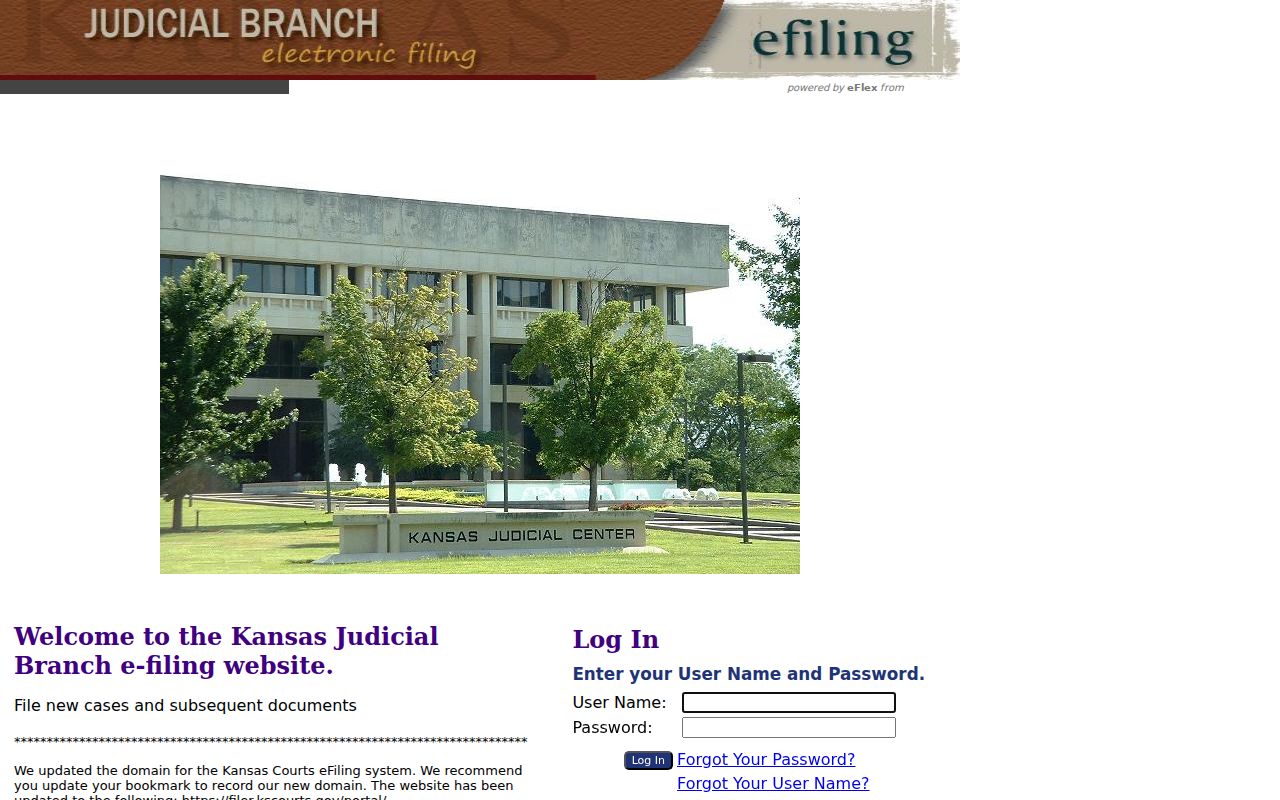
The separation matters: filing a paper and checking when the court will hear it are different jobs handled by different systems.
Miami County Appearance Details
A Miami calendar line may contain more than a date. Observed notes included in-person or Zoom appearance details, an interpreter, stipulated facts, and time estimates. The connection field may carry judge, video, or courtroom information. Those details shape how a person appears, but the brief line cannot replace a court order or direct instruction.
- Connection
- The in-person, courtroom, judge, or remote appearance channel shown for the event.
- Interpreter
- A calendar note that language help is expected or arranged for the setting.
- Time estimate
- The planned length, not a promise that the case will start or end at that exact moment.
- Sealed
- A placeholder that hides party detail under a rule, statute, or court order.
Court Settings: What Each Field Means
Read the whole row before acting. One field supplies context for another, and an event label states what is planned rather than what actually happened.
| Date | The scheduled calendar day; confirm a recent move with the clerk. |
|---|---|
| Time | The listed call or event time, which may differ from when the matter is reached. |
| Courtroom | The assigned room or appearance location shown for that event. |
| Judge | The judicial officer attached to the setting or calendar view. |
| Setting type | The planned event, such as motion, status, arraignment, plea, pretrial, trial, or sentencing. |
| Case number | The identifier that connects the setting to the docket and case record. |
A status conference is not a disposition. A motion setting is not proof that the motion was granted. Likewise, a sentencing label does not disclose the sentence. Open the docket or order for the result.
Miami County Setting Labels
The Miami County court schedule uses short labels to sort different stages. Criminal entries may include arraignment-status, preliminary-examination-status, plea hearing, sentencing, diversion-status, or probation-violation-status. Civil and family entries may show motion, status conference, pretrial conference, or bench trial. Each is a scheduled step, not a final finding.
An “Appeal - Municipal” label has a distinct local meaning. Under K.S.A. 22-3609, a municipal judgment may be appealed to the district court in the county where the city court sits. The label therefore shows a city matter reaching the Miami County District Court calendar. It does not mean every municipal citation will appear there.
When a Miami County Court Date Moves
A continuance postpones a setting. A reset places the event on another date. A cancellation removes the planned setting, but it does not by itself dismiss the case. Miami County warns that processing can lag behind what has happened in court, so a PDF that looks current may still show the prior date.
When two sources differ, call the Clerk of the District Court at (913) 294-3326 and give the case number, the date shown, and the setting type. Ask whether a new order or notice controls. Check with counsel as well. Keep the original notice until the change is confirmed. A party should not assume that a missing calendar line ends the duty to appear.
Note: The clerk's confirmation is the safer source when a same-week Miami County calendar change has not yet reached the PDF.
Miami County Sealed Calendar Lines
The inspected calendar included asterisks and the word “Sealed” in place of party details. That display protects information; it does not reveal why access is limited. Kansas Supreme Court Rule 22 limits electronic access to listed cases and documents, while Rule 24 addresses protected personal data.
A sealed line should not be used to guess the parties or event. The setting can remain on an operational calendar even when public detail is withheld. Ask the clerk whether any public portion is available. Searching harder will not open a nonpublic record.
Miami County Municipal Court Schedules
Paola, Louisburg, Osawatomie, Spring Hill, and Fontana maintain their own municipal authority for ordinance matters. Those city settings are separate from the Miami County District Court calendar unless an appeal or other district matter is opened. The city court named on the notice is therefore the first place to check.
Local schedules differ. Paola commonly sets court on Thursdays. Louisburg uses the second and fourth Tuesdays. Spring Hill has used first and third Tuesday scheduling under an administrative order. These patterns help identify the right clerk, but a holiday, order, or continuance may change a date. Confirm with the municipal court rather than treating a usual weekday as the actual setting.
Missed Miami County Court Settings
Act at once after a missed date. Check the docket for a new entry, contact counsel, and call the clerk that holds the case. Give the case number and the missed event date. Ask what public entry or filed order now controls and whether another appearance has been set.
Missed a setting? A failure to appear can lead to serious court action, depending on the case and the judge's order.
Contact the Miami County District Court clerk or the correct municipal clerk promptly, and seek legal advice about the next safe step.
Do not simply appear at a courthouse without checking where and when the case will be heard. A remote setting, city case, or reassigned courtroom may require a different action. The docket entry and clerk can point to the controlling order.
Miami Appearance Notes Need Context
The Miami County court calendar can carry practical notes that are easy to miss. Entries may identify in-person or Zoom participation, interpreter needs, stipulated facts, and an expected time allowance. Read each note with the court heading, case number, courtroom, and judge or connection reference. A Zoom note on one line does not make every hearing remote. An interpreter notation identifies a logistical need, not the substance of the case. An allotted period helps the court manage its schedule, but it does not predict when the hearing will end.
Municipal schedules also need a current check. Louisburg posts schedule changes on its city homepage. Osawatomie's published 2026 venue at 605 O'Neal Street was described as temporary during Memorial Hall work. Spring Hill's first and third Tuesday schedule comes from a dated administrative order. The court named on the notice remains the best source for the assigned date, location, and any approved change.
When an appearance method or location is unclear, contact the clerk for that specific court. The district clerk confirms Miami County District Court settings. A municipal clerk confirms a city citation. General schedule patterns cannot replace the notice in an individual case.