
Miami County Civil Docket Searches
District civil cases live in Kansas CaseSearch, with Miami picked as the location. An exact case number is the best key. A party or business name works too. Just choose the correct Party Name or Business Name option. To trim a long results list, filter by attorney, judicial officer, case type, status, or filing date.
The portal is not the whole story. Public information and permitted records can also be viewed on the courthouse computer. The Clerk of the District Court at 120 S. Pearl Street, Paola, can route a request. It also answers date questions at (913) 294-3326. For a public paper missing from the web, send the Kansas court-record request form. Name the exact filing in your request.
- Identify the court and civil case category.
- Enter the exact Miami case number when known.
- For a name search, select person or business correctly and add county and date filters.
- Open the matching case and read roles, events, and settings in sequence.
- Ask the clerk for a specific public order, judgment, or other document if needed.
Miami Civil Numbers and Filters
An official Miami public notice shows the district civil pattern MI-YYYY-CV-######. The MI prefix stands for Miami County, the year marks the filing sequence, and the case-type segment must be copied exactly. Never build a number from memory. Use the actual public result, notice, or clerk response.
| Search goal | CaseSearch field | Use |
|---|---|---|
| Known case | Case number | Enter the complete Miami identifier |
| Individual party | Party Name | Confirm role and county before relying on a match |
| Company or agency | Business Name | Select the business option required by the portal |
| Known counsel | Attorney or bar number | Narrow a defined set of filings |
| Case group | Case Type and Status | Separate category and current posture |
| Period | File Date Start and End | Limit recent or historic filings |
Filtering depends on the exact live dropdown options. Treat broad labels as search filters, not as a complete local code dictionary.
Civil Dockets: What They Show
A civil docket is the event-level outline, not the whole file. It can show the caption, case number, case type, party roles, lawyers, judge, filing dates, settings, and document titles. The petition, answer, motion, exhibit, order, or judgment behind an entry is a separate record. Some of those documents carry no public portal link.
| Caption | The District Court of Miami County and the named party roles. |
|---|---|
| Case number | The exact identifier for portal searches and clerk requests. |
| Party roles | Plaintiff, defendant, petitioner, respondent, or intervenor as applicable. |
| Event dates | Filing, scheduled hearing, and later entry dates, each with a different meaning. |
| Setting | Time, courtroom, judicial officer, proceeding type, and appearance notes. |
| Result record | A judgment or order that documents the court’s action. |
A filing is not a ruling. A caption proves no liability. Follow the event sequence and find the filed order before drawing any conclusion.
Miami Civil Party Roles
Miami County civil calendars assign roles that reflect the kind of proceeding. A plaintiff brings a conventional civil claim. A defendant responds. A petitioner opens many family, probate, and special matters. A respondent answers the petition. An intervenor joins an existing case only when the court allows it. Guardian ad litem and court-services roles can appear as well.
- Plaintiff
- The party bringing a civil claim.
- Defendant
- The party responding to that civil claim.
- Petitioner
- The party who initiates a petition-based proceeding.
- Respondent
- The party responding to the petition.
- Intervenor
- A party admitted into a case already underway.
A role maps the structure of the case. It says nothing about the outcome, and the same person can hold a different role in a related matter.
What Cases Fill the Civil Docket
The Miami County District Court handles regular civil disputes. It also handles specialized civil and petition matters assigned under Kansas law. The docket can include contract, tort, property, foreclosure, family, probate, mental-health, and municipal-appeal activity. How much is public varies by case type. Municipal ordinance matters stay with the city clerk unless a separate appeal reaches district court.
- Contract and other regular civil claims
- Tort and property disputes
- Foreclosure and court-sale matters
- Family and domestic proceedings
- Probate, guardianship, and special petitions
- Municipal or administrative appeals filed in district court
Some family and probate details may be visible while key documents stay off the internet portal. Classification alone never proves every part of a file is public.
Miami Public Notices and Files
A Miami County foreclosure or land-related notice can carry the district-court caption, case number, party roles, notice method, response deadline, sale language, property description, and clerk or publication fields. It is still just one published record. It is not the full civil docket, and it omits motions, returns of service, orders, and later dispositions.
Trace the source: determine whether the item came from the District Court Clerk, a sheriff sale notice, the county document center, or a newspaper publication, then use the case number to locate the court event history.
If the case shows but the order does not, request the order by title and approximate date. A precise request routes faster and avoids needless search work.
Hearings on the Civil Docket
Miami County calendar labels include several familiar types. Motion, Status Conference, Custody, Bench Trial, and Hearing are common. Review Hearing, Initial Hearing, Final Hearing, and Post-Termination Permanency also appear. Each label describes a scheduled proceeding. It does not say the event occurred or reveal the judge's ruling. A continuance can push the actual hearing to a later date.
Three dates deserve separate attention. The filed date marks when a case or document entered the system. The scheduled date marks when a proceeding is set. The entered date can reflect when an order or event was recorded. A status conference is not a judgment. A motion hearing does not mean the motion was granted.
Check any setting against the Miami County Docket by Date. Then call the clerk when sources conflict. The county warns that the reference calendar may lag recent hearings or continuances.
CaseSearch and New Civil Filings
Kansas New Civil Filings and CaseSearch serve different needs. New Civil Filings is a separate state source for recently filed civil matters. CaseSearch is the broader statewide system, letting you follow a Miami County case by number, parties, status, dates, and available events.
| Source | Best use | Limit |
|---|---|---|
| Kansas New Civil Filings | Locate recent civil filing information | Not the complete event history or case file |
| Kansas CaseSearch | Follow public case information and events | Some case types and documents are excluded |
| Miami courthouse terminal | View permitted public material absent online | Nonpublic records remain unavailable |
| District Court Clerk | Copies, certification, and focused requests | Rules, exemptions, search work, and fees apply |
Finding a case on the first screen is a start, not the whole file. The full Kansas new civil filings search is the official source, and its listings show what the state's new civil docket entries contain for Miami County cases.
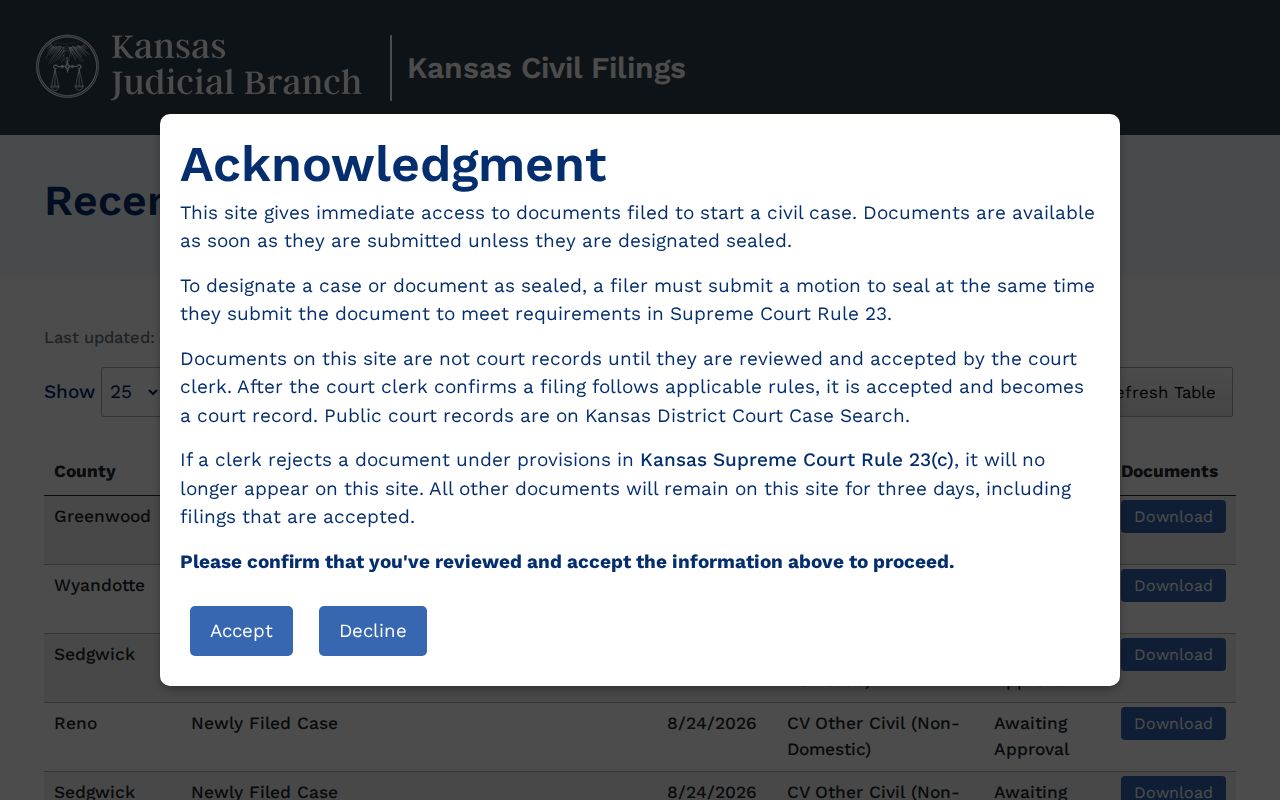
It illustrates the separate recent-filings route that complements, but does not replace, CaseSearch.
Who Can See Civil Dockets
Kansas Supreme Court Rule 22 sets the rules for electronic public access to court dockets. Some case types and documents stay off the portal entirely. Custody, visitation, support, dissolution, guardianship, parentage, and trial-exhibit materials are among the categories that may be unavailable online. Even then, limited case information can show up. A terminal at the courthouse can open public material that the portal holds back. It cannot unlock records that are nonpublic by rule.
Privacy and records rules: Rule 24 protects such data as full birth dates, financial identifiers, minors, and residential addresses. K.S.A. 45-221 recognizes records not required to be open.
A Miami County civil court docket search that returns nothing can mean several things: a misspelled name, the wrong county filter, a case-number format mismatch, rollout timing, processing delays, or an access limit. None of those equals a sealed file. Ask the clerk of the district court before drawing that conclusion.
Miami Civil Court Authority
The Miami County District Court belongs to Kansas's Sixth Judicial District. Linn and Bourbon Counties sit in that district too. The district clerk holds Miami civil case files, calendars, copies, and certifications. State law draws those district lines. City ordinance matters stay with municipal clerks. Federal civil cases run through the federal courts. The official Kansas statute describing the Sixth Judicial District spells out that structure.
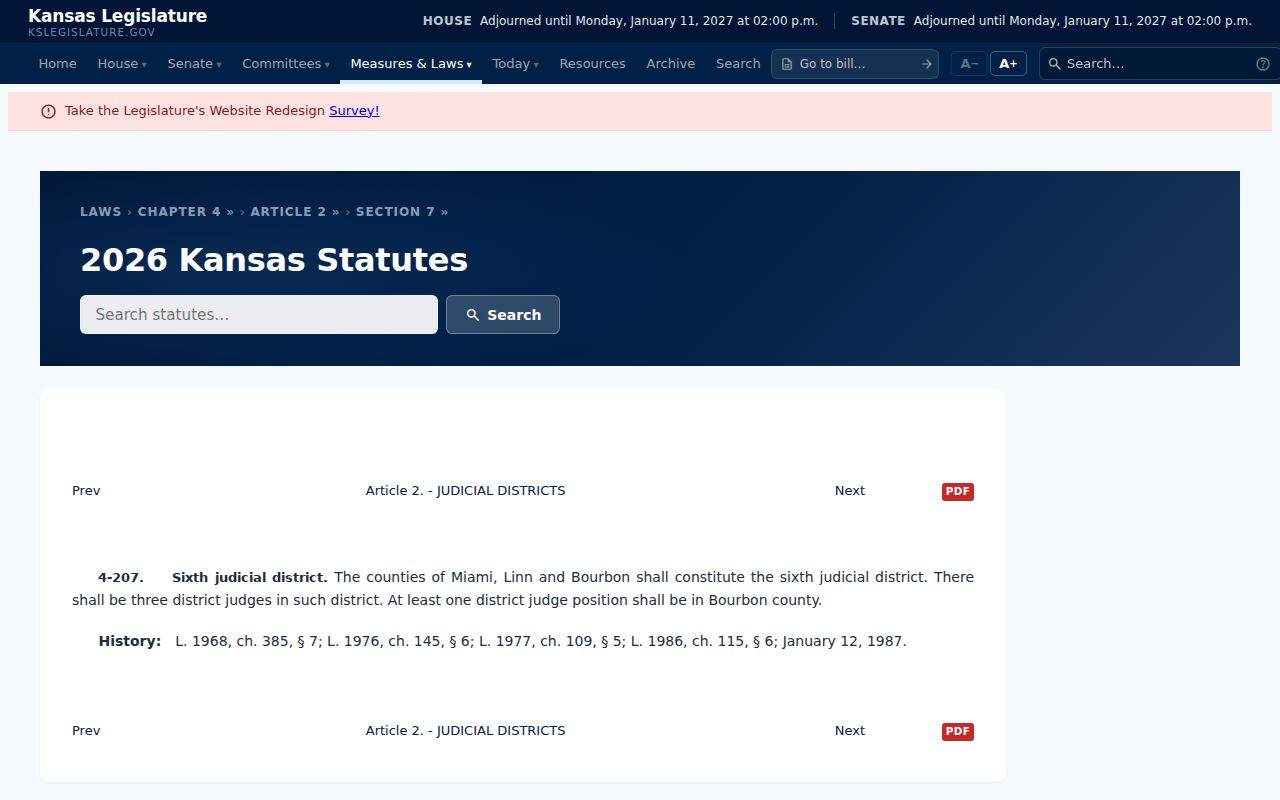
That structure is why Miami County records sit with the local clerk while CaseSearch supplies the statewide search layer.
Need copies past the event view? The Miami County court case records request route covers them. Name the case number, the document, and whether you want certification. Transcripts may involve a separate reporter process and fee, so confirm those details before ordering.
Miami Civil Roles and Filing Dates
A Miami County civil calendar entry can name a Plaintiff, Defendant, Petitioner, Respondent, Intervenor, or Guardian Ad Litem. The label tells you how a party fits the case, not who is right. Plaintiffs and defendants dominate claims for money or other relief. Petitioners and respondents usually appear when one side asks the court for a specific order. An intervenor steps into a case already running because the outcome could touch a separate interest. Keep each role attached to the name, since the same person can hold different roles across Miami County cases.
Dates do different jobs. The filing date marks when a paper entered the court record. A scheduled date points to a planned hearing. An entered date may show when the court recorded an order. A motion setting alone proves nothing about whether the motion was granted. Look for a later order, judgment, dismissal, or other disposition in the docket events. When CaseSearch names a paper but does not display it, request that exact public document from the Clerk of the District Court.
A foreclosure or sale notice can hand you a case number, party caption, property description, and sale date. Treat those fields as search clues, not as the civil file itself. The district clerk's docket remains the source for public petitions, motions, orders, and judgments.