
Miami County Court Record Requests
Kansas CaseSearch is the place to begin. Use it when you need to identify a public Miami County District Court case and its number. The portal shows case information and events, though not every filed document is viewable online. The courthouse public terminal may offer broader access under Kansas Supreme Court Rule 22. When you need a paper copy, a certified copy, or something not online, contact the Clerk of the District Court at 120 S. Pearl Street, Paola, KS 66071. You can also call 913-294-3326.
Requests go through in person, by mail, or by phone for instructions. The official Kansas court-record KORA form is another option. That form lets you pick email, mail, in-person pickup, or fax delivery. Route your request to the right custodian. The county's general records office holds county records. The District Court Clerk keeps the district case files and the court docket.
- Find the case number through Kansas CaseSearch or clerk assistance.
- Name the exact docket sheet, filing, order, judgment, or copy needed.
- Choose portal viewing, terminal inspection, counter, mail, or written request.
- Ask for a fee estimate and identify whether certification is required.
- Review the supplied public record and confirm any missing or restricted portion.
District Clerk or County Clerk
Two similarly named offices keep very different files. The Miami County District Court Clerk holds district-court cases, dockets, calendars, filings, copies, and certifications. The Miami County Clerk, at 201 S. Pearl, Suite 102, handles general county records and elections. Genealogy material and the county KORA route sit there too. A court complaint or judgment does not land there automatically.
Other nearby offices are not substitutes either. The Miami County Attorney prosecutes cases. It does not keep the full docket as a neutral custodian. Sheriff Records holds law-enforcement reports, not court filings. Community Corrections keeps supervision records, not the court file. Sending a request to the right office avoids delays and mismatched fees.
Myth and fact: a county record request is not automatically a court-record request. Send district case material to the District Court Clerk.
Kinds of Court Records
One case can yield several different record products. Ask for the one that fits your need. The docket sheet, or events index, is the chronological list of what the court did. A filed document is the real thing: the petition, motion, answer, order, or judgment itself. A certified copy comes with the clerk's authentication. A portal printout is handy for reference, but it is not a certified court copy.
- Case information and party or case-status fields
- Docket sheets and chronological event indexes
- Pleadings, motions, responses, and attachments
- Signed orders, judgments, and dispositions
- Plain or certified copies of public filed documents
District court can hold civil, criminal, family, probate, mental-health, juvenile, traffic, and municipal-appeal files, and public access varies across them. Protected cases and documents will not appear in a public portal.
Four Miami Court Record Layers
Knowing the layers prevents a common docket search error. Case information identifies the file. The events index lists what happened and when. A filed document holds the text submitted to or signed by the court, and certification proves the clerk authenticated the copy.
Case information: number, type, status, parties where public, and assignment fields.
Events index: dated entries for filings, settings, orders, and dispositions.
Filed document: the actual public paper or electronic image, when accessible.
Certified copy: a clerk-authenticated reproduction for a use that requires official proof.
An event label on the docket does not guarantee the linked document can be downloaded. If the portal stops at the index, ask for the exact filing by title and date.
Court Records: What They Contain
A public file can contain identity, classification, scheduling, filing, and outcome fields, and the exact set depends on case type and access level. Kansas case numbers combine a year, a case-type code, a sequence, and county context. Use the number exactly as the court shows it. Do not invent missing digits.
| Case number | The court’s unique file identifier, such as a Miami County format shown as YYYY-XX-##### |
|---|---|
| Case type and status | The legal category and whether the matter is open, closed, or otherwise classified |
| Events | Dated filings, settings, rulings, and disposition entries |
| Pleadings | Petitions, complaints, motions, answers, and other filed papers |
| Orders and judgments | Signed court rulings and final decisions where public |
| Calendar data | Date, court, connection, role, setting, and courtroom fields when scheduled |
Rule 24 requires careful handling of protected personal information. Notes kept from a court records search should preserve the useful field labels while leaving private values out.
Kansas Court Request Form
The official Kansas court-record request form asks for your contact information. It also asks for the court and county, plus a specific description of the record. Include the case number if you know it. If you do not, give a party or business name, the case type, an approximate filing year, and Miami County. Then name the item itself, whether a docket sheet, a document, an order, or a certified copy.
You can choose inspection or copies on the form. Email, mail, pickup, or fax delivery are options too, and the form covers cost estimates. A narrow request, such as "the order filed on a stated date," moves faster than "all records." If part of a file is restricted, ask for the separable public portion. Also ask for a written explanation of the withholding basis.
Copy Fees and Certification
Miami County's court-copy price comes from Sixth Judicial District Local Rule 2. That rule was filed August 21, 2025. Non-confidential papers from the District Court Clerk cost $0.50 per page. The judge can waive the fee. Certification runs $1 per certification. The rule allows cash or check and states the charge is not taxed as case costs.
| Item | Amount |
|---|---|
| Miami County photocopy from non-confidential file | $0.50 per page |
| Clerk certification | $1 per certification |
| Transcript, unusual media, research, postage, or other service | Ask clerk for estimate |
The local rule sets no Miami County transcript or exemplification fee, and certification is not a transcript fee. Get an estimate before ordering a long file.
Miami Records Request Instructions
The official Miami County request page lays out the general county process and the three-business-day expectation for an agency to act, which can mean production, a delay notice, or a denial. District case files still belong with the court custodian.
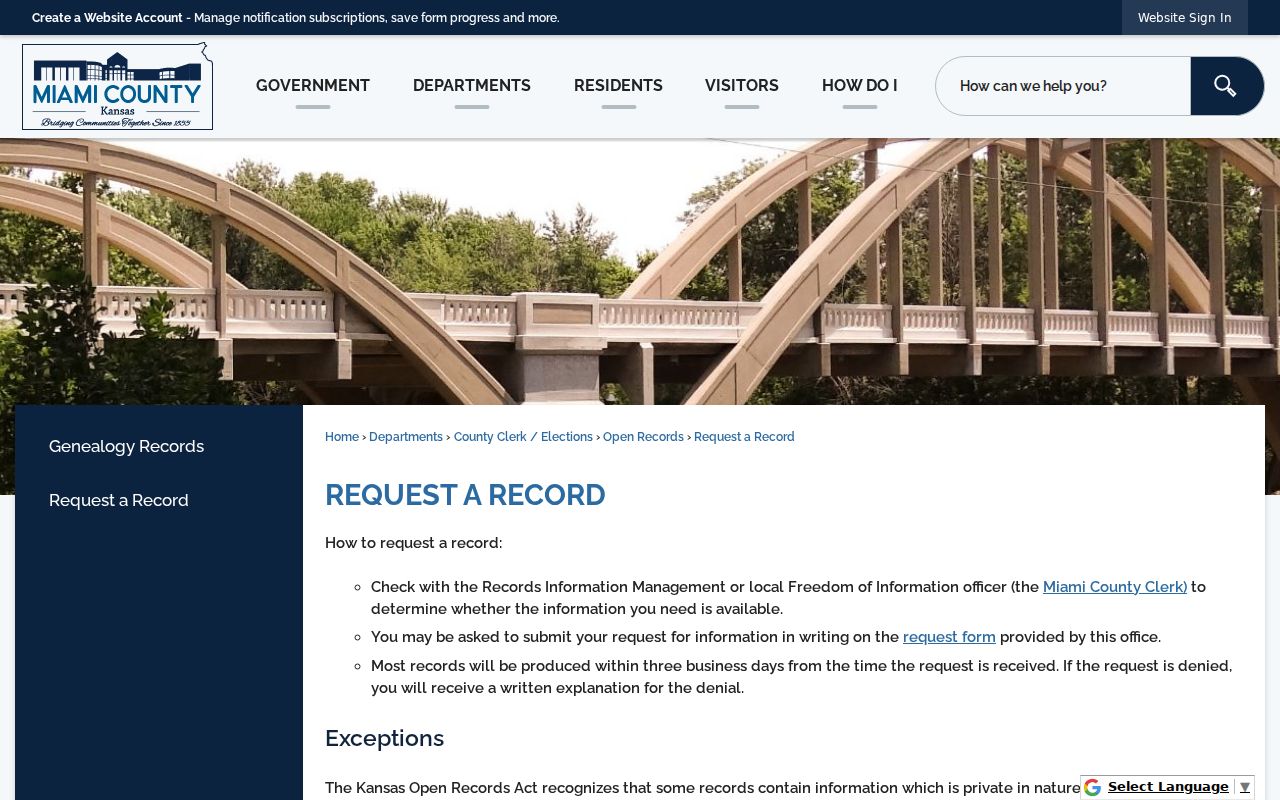
That county framework is useful context. It still does not move a district case file to the general county clerk.
Access Rules for Court Records
Public electronic access to Kansas district and appellate case records runs through Kansas Supreme Court Rule 22. Under that rule, portal users see less than courthouse-terminal users in some areas. Two other limits matter just as much. Rule 24 makes filers responsible for redacting protected personal information, and sealed, expunged, juvenile, adoption, grand-jury, protection-order, and other protected records may be absent or restricted by rule, statute, or court order.
Public portion: K.S.A. 45-221 allows exemptions, while releasable material may be separated from restricted content. Ask for the public portion rather than assuming the whole file is closed.
Miami County District Court Clerk
120 S. Pearl Street
Paola, KS 66071
Phone: 913-294-3326
Fax: 913-294-2535
Miami Open Records Policy
The county’s official open-records policy provides useful KORA context and links fee material.
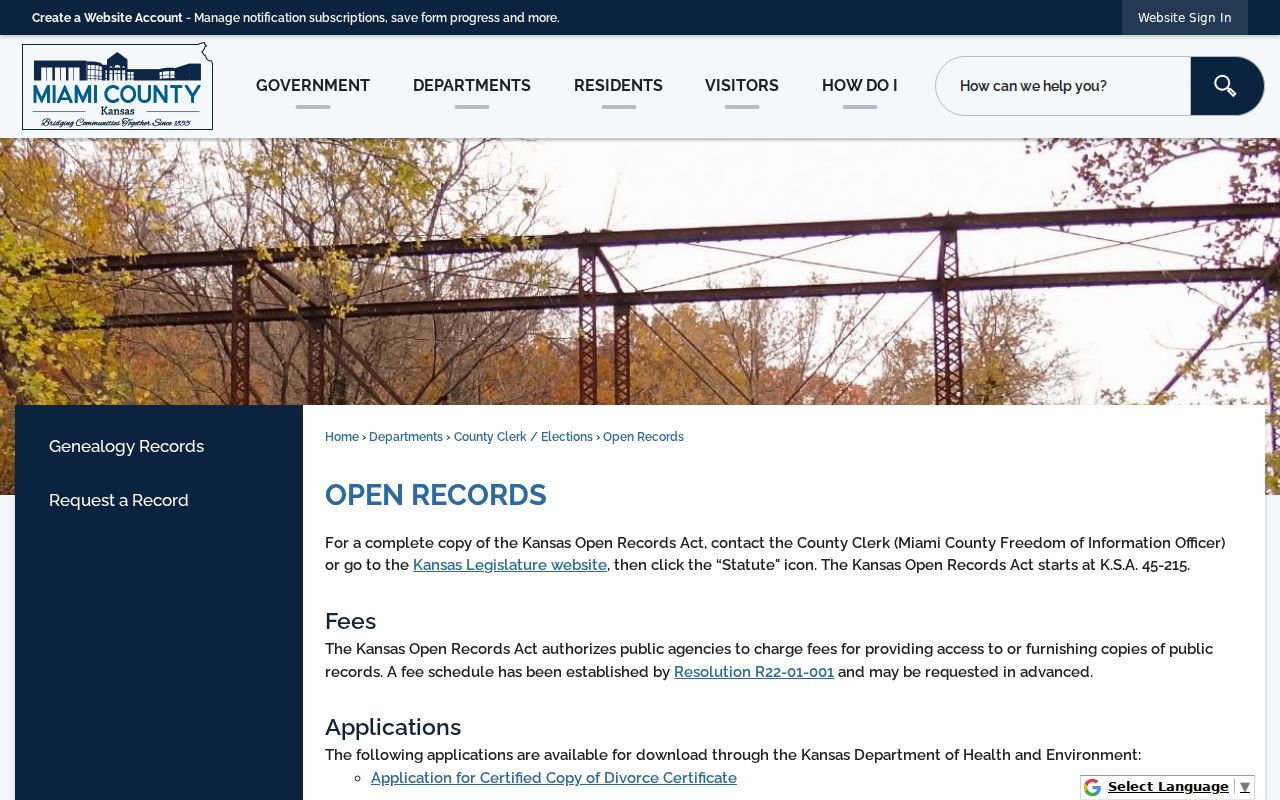
The policy points you to the office that actually holds each record. The district court file itself answers to court access rules and local court fees.
Sheriff Fees Are Different
Sheriff charges live on their own schedule. The Miami County Sheriff fee page covers accident reports, initial reports, supplements, and media. It sets no copy charges for the District Court Clerk, so do not read one fee table as covering both offices.
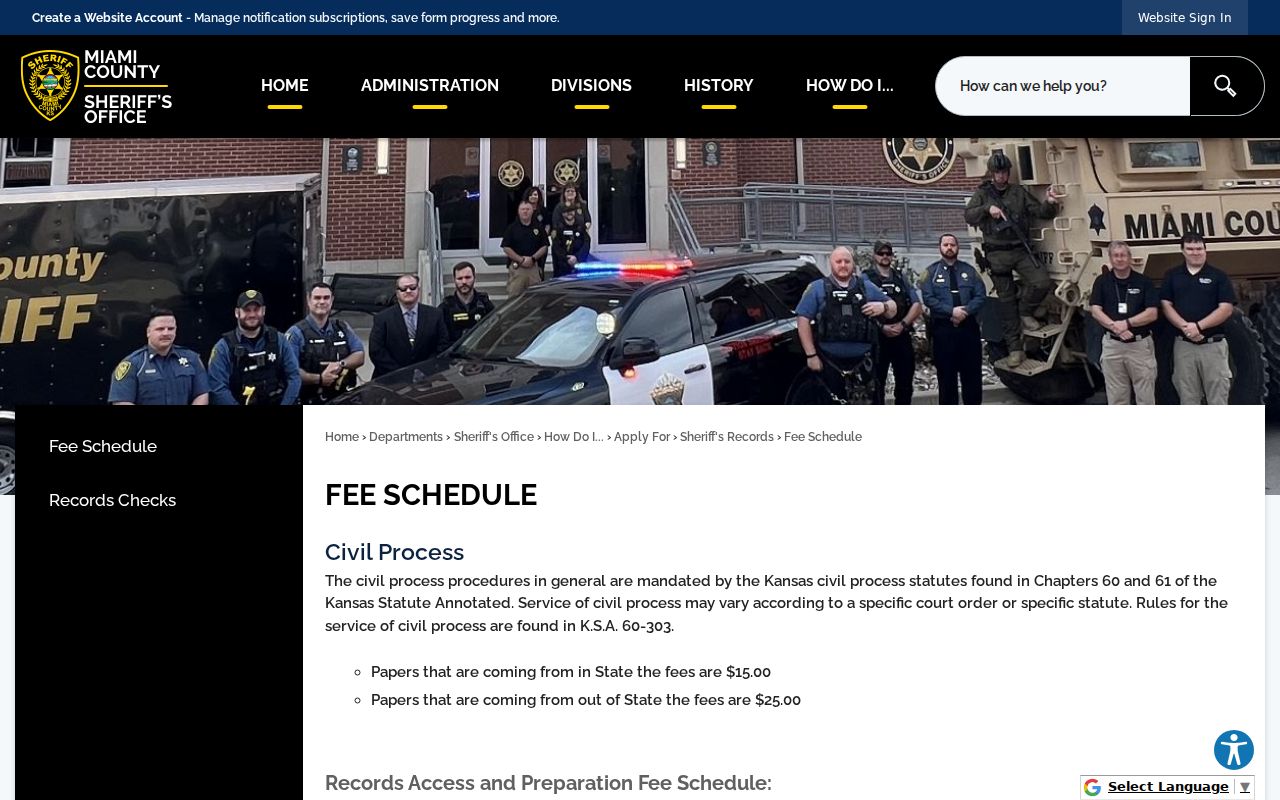
That line between the two offices matters. A police report documents law-enforcement activity; a complaint, docket, order, and judgment belong to the court file and its clerk.
Historic Miami Record Routes
Genealogy coverage has limits. Materials covering Miami County from 1885 through 1911 are not the full District Court archive. Marriage records from 1857 to the present route to the District Court Clerk. But that vital-record route is not a general family-law case search. Basic case information may be electronic. Even so, older district records may sit on paper or another archived medium. The county foreclosure FAQ confirms the District Court Clerk maintains the case file. You need a case number. A sheriff-sale notice is a separate document from the foreclosure court file. The official Miami County FAQ lays out that routing.
Chasing an older Miami County file? Ask about the terminal, the paper file, microfilm, or the archive. A missing online image does not mean the record is gone.
Specific Miami Document Requests
A narrow request gets better results. Name the Miami County court, the case number, the filing title, and the filing date. Say whether you want inspection or a copy. Without a case number, give the case type and the approximate year. Also give enough public party information for the clerk to identify the file. Skip bulk list requests when one known case will answer the question. Good examples help. One request might seek the events index. It could also name a single order entered on a known date. Another might ask whether a public judgment can be inspected at the terminal. That check comes before copies are ordered. If no image is online, ask whether the paper file or archived medium exists. For a partly restricted record, request the nonexempt segregable portion. The Kansas form asks for exactly this specificity. It cuts search time and needless reproduction charges.
Plain, Certified, or Portal Copy
Three copy types serve three purposes. A portal printout is a handy reference to public case information. A plain clerk copy reproduces a filed public document. A certified copy adds the clerk's official authentication. Ask the receiving office what it requires before paying for certification. The $1 certification charge applies per certification. The underlying Miami County pages bill at the local copy rate. Transcripts follow a different path. They reproduce spoken proceedings and may involve a court reporter or a separate process. The clerk sets no official Miami transcript fee on the basic schedule. Contact the clerk for the route and an estimate. The same caution applies to exemplification, apostille, unusual media, postage, and staff research. None of it should be priced from the page-and-certification table. Get the estimate in writing. That way the local photocopy rule is not stretched past what it covers.